(Part Two in the “Collective Grief” Series)
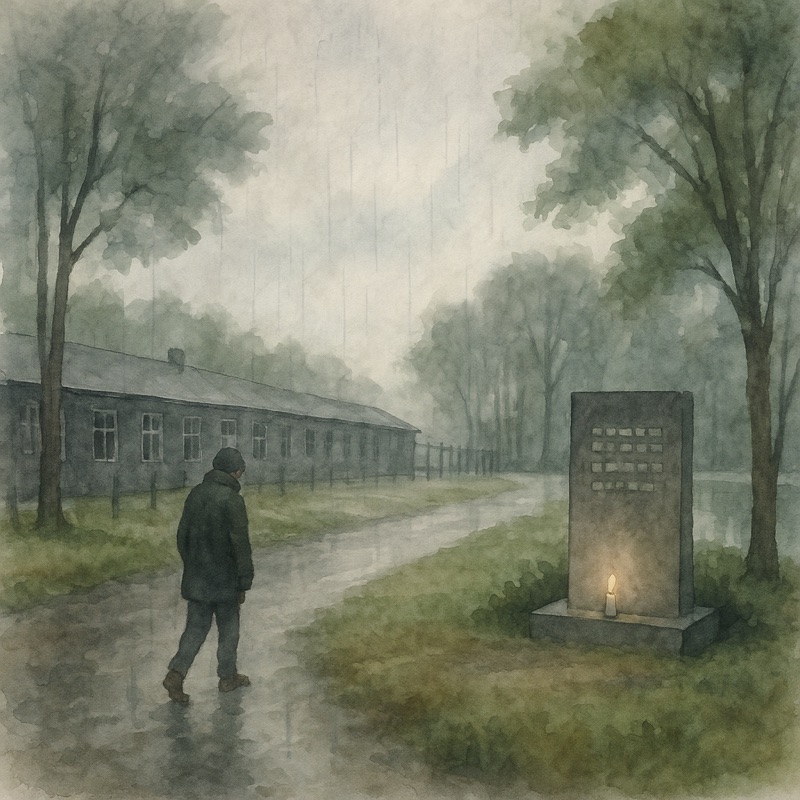
It was raining the day I visited Kamp Vught, a concentration camp outside Amsterdam.
Cold, steady rain. Even in my warm layers, I felt the chill settle into my bones. I tried to imagine the prisoners who once stood here — wearing only thin linen clothing, short sleeves in the winter, handed whatever size was available regardless of fit. The thought made the cold sharper somehow, as if my own body remembered a pain it had never known.
Walking through the grounds felt like a vigil.
Each step carried the weight of the thousands who were forced to live and work here — Jewish families, political prisoners, resistance members, Roma and Sinti people, Jehovah’s Witnesses, and others the Nazis deemed unworthy. The rain fell softly on the earth that once held their fear, their hope, their last breaths. Around me, the trees whispered in the wind, and the nearby river moved with a kind of indifferent grace. The world has healed on the surface, but beneath it, grief still hums.
The most heartbreaking place was the children’s memorial.
It listed the names and ages of the children who died here — from infants just a few months old to teenagers barely sixteen. They were considered “worthless” by the SS because they were too young to work. Standing before their names, I felt my throat tighten. The rain blurred my vision, or maybe it was tears. As a mother, I couldn’t bear to imagine the depth of that loss — hundreds of young lives extinguished, their laughter and futures stolen.
I took no pictures that day.
It felt like a betrayal — to frame something sacred, to turn grief into image. Some places are meant to be remembered, not recorded.
As I stood there, I thought of my daughter — and how grief, too, is a quiet witness. It lives in us the way the past lives in the earth: unseen, but ever-present. In that place of collective loss, our sorrows met for a moment — theirs and mine, history’s and the heart’s — bound by love that refuses to be forgotten.
There is holiness in remembrance.
In choosing not to look away, in walking softly through the rain, in honoring both the lives lost and the life that continues. The earth holds it all — pain and beauty, memory and mercy — and in bearing witness, we keep love alive.
Historical Note
Kamp Vught — officially known as Konzentrationslager Herzogenbusch — was the only SS concentration camp in the Netherlands. Between 1943 and 1944, more than 30,000 people were imprisoned there, including Jewish families, resistance members, Roma and Sinti people, and others. Thousands were deported from Vught to extermination camps such as Sobibor and Auschwitz, and ten women died in the notorious “Bunker Tragedy.” Today, the site stands as a national memorial — a place where the earth itself bears witness.